A rural lot can look perfect and still be a difficult place to put a house. The view, the trees and the price are the easy things to judge. What decides the build is underneath: what the soil will take for a septic system, where water is going to go, how the driveway meets the road, and how far power has to travel.
These are the checks worth making before an offer goes firm, anywhere from Tatamagouche to River John to the Musquodoboit Valley. For larger properties, see also the acreage builds page.
Start with the septic, not the house plan
Everywhere in Nova Scotia outside a serviced area, a house needs an approved on-site sewage system, and the approval comes from the province rather than the municipality. A Qualified Person, either a QP1 who is a professional engineer or a certified QP2, walks the lot, assesses the soil and looks at everything that limits where a system can go: property boundaries, watercourses and any nearby wells. They then select a system from the provincial standard, or design one, and obtain a notification receipt or approval number from Nova Scotia Environment and Climate Change. A certified installer builds it, and the Qualified Person inspects the installation.
What this means for a buyer is simple. The lot assessment tells you what kind of system the lot can take, and the difference between a standard field and a raised or engineered system is thousands of dollars. It is worth paying for that assessment during a conditional period rather than after closing.
It also sets the schedule. The municipality will not issue a building permit without the septic approval, so a delay at this stage delays everything. Permit fees and steps for each municipality are in what a building permit costs.
Water, and what is in it
Most rural lots in this part of the province mean a drilled well. Depth and yield vary by area and by bedrock, and neighbours are the best source of realistic numbers. If the houses up the road went 200 feet, budget for 200 feet.
Quality matters as much as quantity. Nova Scotia bedrock puts arsenic, uranium and manganese into well water in parts of the province, along with more common iron and hardness. None of that stops a build. It does mean a full chemistry test once the well is in, and possibly treatment equipment with a place to live inside the house. Leaving room in the utility room for it during design is easier than finding room later.
The driveway is a permit, not a detail
Where a driveway meets a public road, it needs approval, and a culvert if there is a ditch. In the Municipality of Colchester the driveway approval can be applied for with the building permit. On a provincial road it goes through the province. Either way it is an item with a lead time.
The physical work is more than it looks. A driveway on a rural lot usually means clearing, grubbing, geotextile in wet spots, a base course and a culvert set at the right elevation. On the East Mountain build the driveway, pad and culvert went in as part of the site work, before the house had walls.
Where water goes when it rains
Red clay till holds water (see the Colchester County guide). Shallow soil over bedrock sheds it, which is common in Pictou County. Both mean that water has to be given somewhere to go before the house shows up. Look at a prospective lot in a wet week rather than a dry one, and look uphill: water that arrives from a neighbouring property is still your problem once a house is in its path.
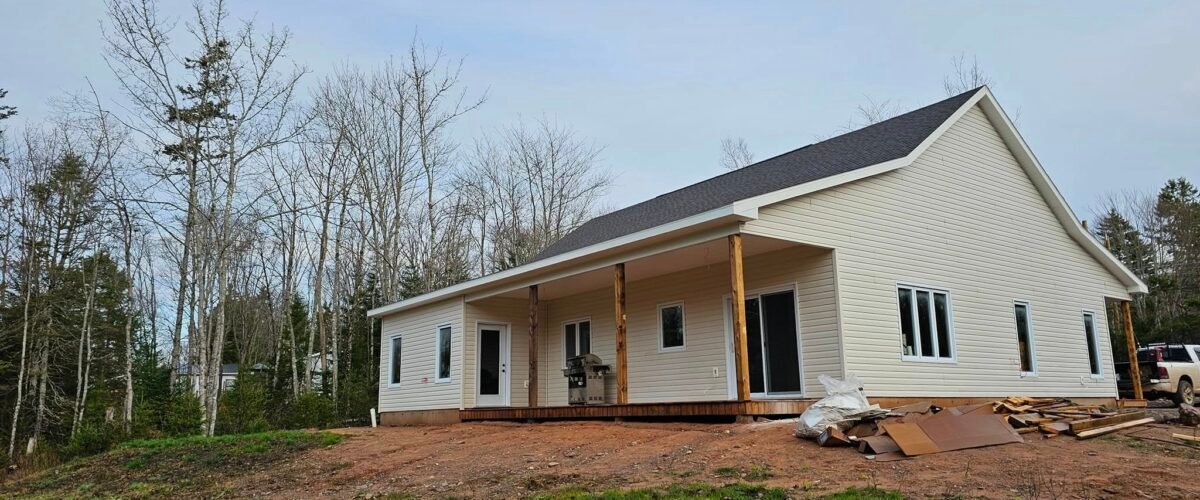
Practical measures are unglamorous. Site the house on the high point where possible, grade away from the foundation, run drainage to daylight rather than into a low corner, and keep the finished floor elevation above the surrounding grade. Fixing drainage after a house is built costs several times what doing it during excavation does. The rural custom home build in the portfolio shows a finished country house and its site.
Power, and how far it has to come
A long driveway is also a long power run. Poles cost money, and the utility’s contribution only covers so much. Ask for a cost estimate before assuming the number is small, particularly on a lot set well back from the road. Underground service is possible and costs more, but can be worth it in an exposed spot.
Zoning and setbacks
Before any of the above, confirm what the land use by-law allows on that lot. Minimum frontage, setbacks from property lines and watercourses, and rules about second dwellings all vary between municipalities and, in HRM, between planning areas. A development officer will answer this question, and their answer is the one that counts.
A short list to take to a showing
- Has a lot assessment been done, and can it be shared?
- Is there a well on the property, and is there a water test?
- Where would the driveway meet the road, and is there a culvert?
- Which municipality issues the permit, and what zone is the lot in?
- How far is power from the building site?
- What does the lot look like after two days of rain?
JGC Construction builds on rural lots across Colchester, Pictou and Halifax counties and is happy to look at a property before it is bought; a site visit is the first step in JGC’s process. When the lot checks out, the custom home building page is the next stop. For a second opinion on a lot, get in touch.