Colchester County covers a lot of ground. It runs from the Cobequid Bay farmland around Truro and Bible Hill north to Tatamagouche and the Northumberland Shore, west through Great Village and Debert, and south to Stewiacke and Brookfield. Building a house in Truro and building one on a woodlot in East Mountain are two different jobs, and the paperwork is different too.
Here is how the process actually runs in this county, based on the permits, approvals and ground conditions that come up on JGC Construction sites.
Who issues your permit depends on which side of the town line you are on
The Town of Truro handles permits inside town limits. Everywhere else in the county, including Bible Hill, Valley, Onslow, Tatamagouche, Debert and the rural roads in between, permits come from the Municipality of Colchester. The Town of Stewiacke runs its own town office as well, so a lot near the Stewiacke line is worth checking before an application goes in.
The fees are not the same either. As posted in September 2026, the Municipality of Colchester charges a $25 development permit fee plus 10 cents per square foot for residential construction. The Town of Truro charges 6 cents per square foot with a $25 minimum. Fee schedules change, so confirm the current rate when you apply.
Fees and process differ again in Pictou County, Halifax County and East Hants; there is a side-by-side comparison in what a building permit costs across these municipalities.
In the county there is an order to it. A development permit comes first, which is the municipality checking the project against the Colchester Land Use By-law: setbacks from property lines, watercourses and the road. The building permit follows. Colchester now takes applications online, which has cut out a lot of driving to the office on Church Street.
What the county wants to see with the application
For a new house in rural Colchester, the application needs four things:
- Approval for the sewer or septic system
- Driveway approval, since most rural driveways meet a provincial or municipal road
- A full set of building plans (JGC works through the floor plan with you as part of a custom home build)
- A plot plan showing where the house sits, with distances to property lines, other buildings and any watercourse
The plot plan is where rural lots get held up. A brook at the back of the property, a wet spot that only shows in April, or a neighbouring well can all move the house or the septic field. That is worth knowing before a foundation is priced, and it is why JGC’s process starts with a site visit on the lot itself.
Septic and well come before the house
Outside the serviced areas around Truro and Bible Hill, a house needs its own septic system and its own water. The septic side is provincial, not municipal. A Qualified Person, either a QP1 who is a professional engineer or a QP2 with the training and certification, does a lot assessment, looks at the soil, and selects or designs a system that fits the property and its confining features. They get a notification receipt or approval number from Nova Scotia Environment and Climate Change. Only then can a certified installer build it, and the Qualified Person inspects the work as it goes in.
Two things follow from that. First, the septic approval has to be in hand before the municipality will issue the building permit, so booking the assessment early matters more than most people expect. Second, if the assessment comes back requiring a raised or engineered system rather than a standard field, the cost changes by thousands of dollars. Getting that number before closing on a lot is cheaper than getting it after. The guide to buying a rural lot covers the well, driveway and power questions that go with it.
The ground here has opinions
Much of Colchester sits on red clay till. It holds water, it moves when it freezes and it turns to soup in a wet spring. Footings have to sit at least 1.2 metres below grade to stay under the frost, and on a clay lot that depth is the easy part. Drainage is the part that decides whether a basement stays dry in year five. It matters even more on larger country properties, covered on the acreage builds page.
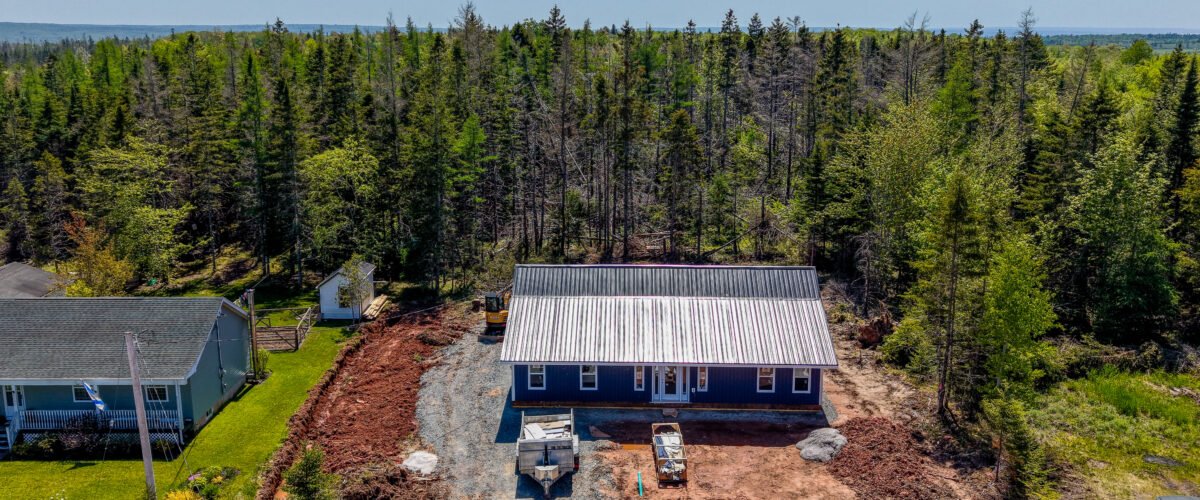
On the East Mountain build near Truro, the site work included a gravel driveway and pad, a concrete culvert at the road, and trenching to move water away from the house through exactly that red clay. None of it shows in the finished photos, and all of it is why the house sits dry. See the East Mountain home build for how that lot came together.
Weather the house has to stand up to
The north end of the county faces the Northumberland Strait, and the Cobequid Bay end funnels wind up the valley. Post-tropical storms that reach this far north arrive with the wind already spread wide, so exposure, not the storm’s name, is what matters. Roof-to-wall and wall-to-foundation connections carry that load (more on that in what holds a roof down in a storm), and steel roofing has become the default on exposed sites because it sheds snow, stays put in high wind and does not need replacing in fifteen years.
Nova Scotia is also midway through adopting the 2020 National Building Code, phased in from April 2025 through 2029, with the energy requirements stepping up along the way. A house designed two years ago and built now may not meet what the inspector is checking against. It is worth asking whoever drew the plans when they last updated them.
What this looks like on a real schedule
For a rural Colchester build, a workable order is: lot assessment and septic design, development permit, building permit, driveway and culvert, excavation and footings, framing and roof, then the mechanical and interior work. The approvals at the front end are the part people underestimate. The building itself runs on a schedule a builder controls. The approvals run on someone else’s.
Not every Colchester project is a new house. Recent work includes metal roofing in Truro and Lower Harmony, a rental renovation in Bible Hill, and a multi-unit build at Creamery Landing in Tatamagouche. Additions to existing homes go through the same permit steps as a new build.
JGC Construction works across Colchester County, from Truro and Bible Hill to Tatamagouche, East Mountain, Harmony and the North Shore, and also takes work in Pictou and Halifax counties. Browse the portfolio for more local projects, or read about custom home building with JGC. To talk through a lot or a set of plans, get in touch.