The stretch of coast from Tatamagouche through Bayhead, Brule and Tatamagouche Bay, east past River John toward Pictou, is some of the most sought-after building land in northern Nova Scotia. The water is warm by Atlantic standards, the summers fill up the communities, and lots that were farmland a generation ago now sell as building sites. The shore straddles two counties, covered in the Colchester and Pictou County guides.
Building on them is not the same as building inland, and the differences show up in the first week and again in year ten.
Wind is the main design problem
An exposed shore lot has nothing between it and the water. That changes uplift on the roof, pressure on the walls and the load path that carries both down into the foundation. The details that matter are ordinary ones done properly: roof-to-wall connections, a continuous load path from rafters and trusses through the wall framing to the anchorage in the foundation, correct fastening schedules on sheathing, and proper strapping rather than assumptions. It is the core of good framing.
Post-tropical storms reach the Northumberland Shore regularly, and the houses that come through them are not built with anything exotic. They are built with hardware in the right places and nails at the right spacing.
Salt air shortens the life of the wrong materials
More on the framing side of that in what holds a roof down in a Nova Scotia storm.
Salt spray carries inland further than most people expect. It shows up as corrosion on fasteners, hardware, light fixtures and anything unprotected on the exterior. Steel roofing with a quality coating holds up well and has become the default along this shore, and siding choices matter just as much. Flashing details deserve more attention here than inland, because wind-driven rain finds anything that was installed casually.
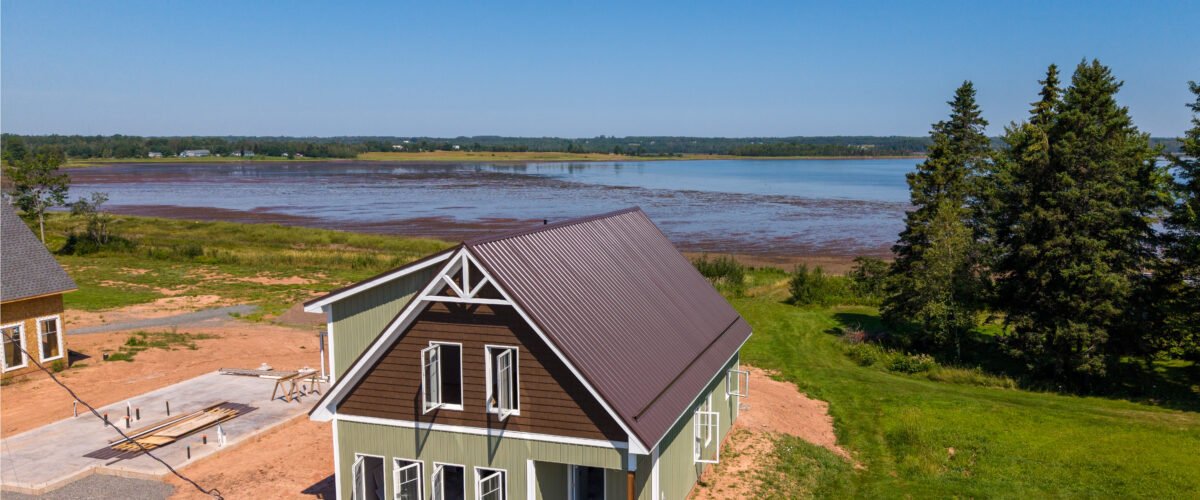
The waterfront home in Bayhead is a fair example of the type: a storey-and-a-half on the shore of Tatamagouche Bay, with a steep roof pitch, a brown steel roof, and a shed dormer giving the upper floor full-height space.
Setbacks and where a house can actually sit
Waterfront lots carry setbacks that inland lots do not. They come from the municipal land use by-law, and they interact with the septic system, which has its own required separations from watercourses and wells. On a narrow shore lot those two sets of rules can leave a smaller buildable envelope than the lot’s dimensions suggest.
Anyone buying for a view should have that envelope confirmed before the offer goes firm. It is a straightforward question for a development officer and a Qualified Person, and the answer determines the house that fits. The guide to buying a rural lot lists the other checks.
Coastal lots and water
Low-lying shore property can flood, and storm surge on the Northumberland Strait has pushed water further inland in recent years than older maps suggest. Elevation is the cheap defence: siting the house on the higher part of the lot and keeping the finished floor well above grade costs nothing extra at design stage and cannot be added afterward.
Shore lots also tend to be sand or shallow soil over rock rather than the red clay of inland Colchester, which changes both excavation and what the septic assessment will allow.
Seasonal to year-round
A lot of building on this shore is converting or replacing seasonal cottages. Older cottages were framed light, insulated thinly if at all, and set on piers or shallow foundations that were never meant to carry through a winter. Bringing one up to a year-round standard usually means new foundation work, new insulation and air sealing, updated wiring, and a heating system that can handle February rather than August.
Sometimes that adds up to more than a new build on the same footprint, and it is worth pricing both before committing, along with an addition if the cottage is sound but small. A builder who says so before the demolition starts is doing the owner a favour.
Building season on the shore
Summer is the best working weather and also when the communities are busiest. Road access, material deliveries and neighbours all factor into a summer schedule near the water. Fall and winter work is perfectly feasible for framing and closing in, and a build that is weathertight by December can carry on inside through the winter. Up the road in Tatamagouche, the Creamery Landing project shows multi-unit framing on the same stretch of shore.
JGC Construction works along the Northumberland Shore from Tatamagouche and Bayhead through to River John and Pictou County, and inland across Colchester County. See more local work in the portfolio. To talk about a shore lot or a cottage that needs to become a house, get in touch.