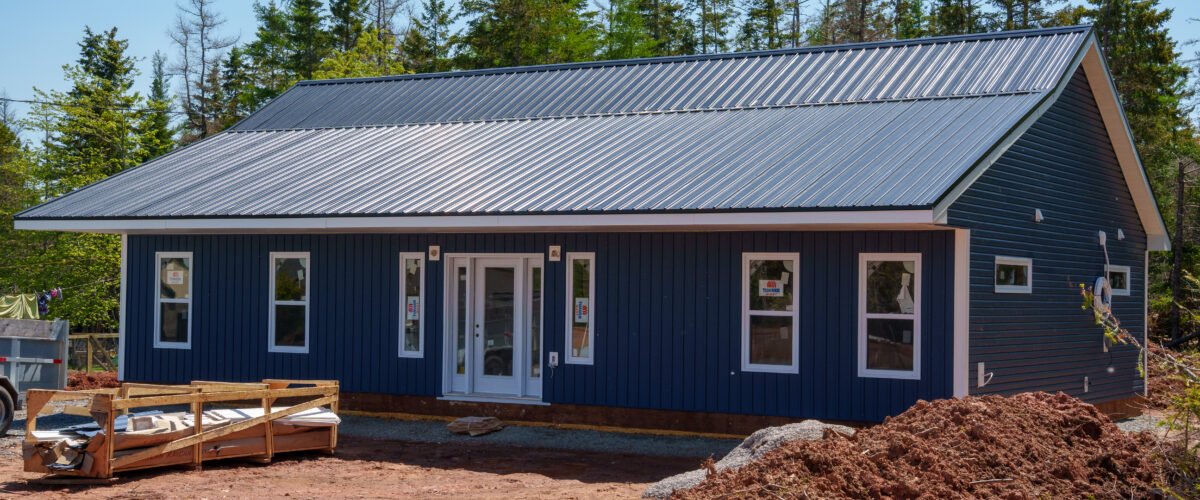
Pictou County has two kinds of building lots and they come with two different sets of rules. There are the serviced lots inside New Glasgow, Stellarton, Westville, Trenton and the Town of Pictou, where town water and sewer are at the road. Then there is everything else: the rural county that runs out to Scotsburn, West River, Hopewell, River John and the shore, where a house needs its own well and its own septic.
The difference changes the budget, the schedule and who issues the permit. For a side-by-side look at fees, see what a building permit costs across the municipalities JGC works in.
Town or county, and why it matters first
The Municipality of Pictou County covers the rural parts of the county. Its building officials work out of 46 Municipal Drive in Pictou, and applications are handled by appointment rather than over a counter, which means a call or an email to buildingpermits@munpict.ca is the first move, not the last. The towns of New Glasgow, Stellarton, Westville, Trenton and Pictou each handle permits for lots inside their own boundaries.
A development officer administers the land use by-law and subdivision by-law, and building officials issue the permit and inspect against the Nova Scotia Building Code. Those are two separate jobs and two separate reviews. On a straightforward lot in an existing subdivision, that is a formality. On a lot being carved off a larger parcel, or one where the zoning does not obviously match the plan, it is the part that decides whether the project happens at all. Larger rural parcels bring their own questions, covered on the acreage builds page.
Water and septic on a rural Pictou lot
Outside the towns, the same provincial process applies as everywhere else in Nova Scotia. A Qualified Person assesses the lot, chooses or designs the septic system around the soil and the lot’s confining features, and obtains the approval number from Nova Scotia Environment and Climate Change before a certified installer can build it.
There is more on this in the guide to checking a rural lot before you buy it.
Pictou County adds its own wrinkles. Parts of the county sit on shallow soil over bedrock, and a lot that looks flat and dry can still fail a standard field because there is not enough depth to work with. Along the West River and the East River the water table sits high. Neither problem stops a build. Both change the system, and the system changes the price. The assessment is a few hundred dollars and it answers the question before the lot is paid for.
The shore is a different build
From Pictou harbour out through River John and along the Northumberland Strait, lots are exposed to salt air and onshore wind in a way that inland lots are not. Practical effects: steel roofing and quality flashing earn their cost quickly, fasteners and hardware should be rated for coastal exposure, and roof-to-wall connections matter more than they do in a sheltered valley. The article on building on the Northumberland Shore goes into this in more detail, and the waterfront home in Bayhead shows what it looks like finished.
Shore lots also carry setbacks that inland lots do not, set by the municipal land use by-law and by how the lot relates to the water. Anyone buying with a view in mind should have the buildable envelope confirmed in writing before the offer goes firm, because the difference between where a house can sit and where the seller imagined it sitting is often twenty metres.
Renovation and rental work in the towns
The housing stock in New Glasgow, Stellarton, Westville and Trenton is largely older, and much of the current work in those towns is renovation rather than new construction: bringing an older house up to a rentable standard (like this rental renovation in Bible Hill), replacing failed roofs, opening up small rooms, and updating wiring and heat. JGC takes on that kind of interior work, along with siding and decks. Heat pumps go into most of these projects now, and they change how the rest of the work is planned.
Renovation permits are easy to overlook and worth taking seriously. Structural changes, new wiring and anything that alters egress need a permit, and an unpermitted renovation surfaces later, usually during a sale or an insurance claim.
Scheduling around a Nova Scotia year
Excavation is straightforward from late spring through fall. Winter foundation work can be done, but frost protection costs money and time. The practical consequence is that permits and septic approvals filed in January and February line up with a spring start, while the same paperwork filed in June competes with everyone else’s summer.
Framing, roofing and closing in a building run year-round. What stops work is not cold so much as freezing rain and wind, and those are the days a crew loses whether the calendar says November or April.
Working across county lines
JGC Construction is based in Truro and takes work across Pictou County, including New Glasgow, Stellarton, Westville, Trenton, the Town of Pictou, River John and the rural areas in between. Recent projects give a sense of the range: a multi-unit build at Creamery Landing in neighbouring Tatamagouche, and metal roofing work on older homes. There is more in the portfolio, and the guides to Colchester County and Halifax County cover the neighbouring areas.
To talk about a lot, a set of plans or a renovation in Pictou County, get in touch.